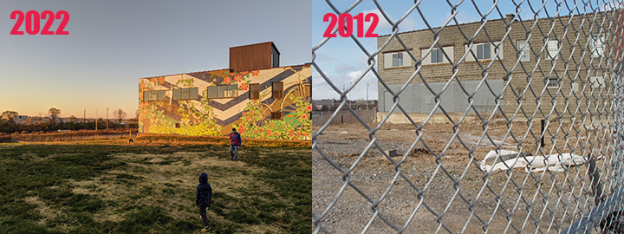
For nearly two decades, the vacant lot at 1318 Niagara Street has reflected the challenges of Buffalo’s industrial past—and the persistence of its neighbors.
After demolition of the former Curtis Malting building in 2006, the site was left contaminated with pentachlorophenol (PCP). Fenced off and unused, it attracted dumping and graffiti, becoming a visible barrier to revitalization along Niagara Street. Neighbors, including Vision Niagara, pressed the City to address the problem.
The New York State Department of Environmental Conservation (DEC) oversaw cleanup and issued a Record of Decision in 2020, determining the site could be safely used by the public. Because full removal of contaminants was not feasible, the property was capped and covered with two feet of clean soil—allowing public access while limiting future use to passive recreation.
With environmental clearance in place, Vision Niagara worked with Councilmember David Rivera to secure a zoning change permitting park use. Funding for design followed, and community stakeholders collaborated throughout the pandemic to imagine a pocket park for the site.
Additional environmental reviews, lost samples, required easements, and interagency approvals slowed progress. As of early 2026, final environmental documents are nearing completion. Once City staffing transitions are finalized, community engagement around the pocket park will resume.
The goal has remained constant: transform a long-neglected site into a safe, welcoming public space for the neighborhood.

2007 – demolition of Curtis Malting nearing completion
1318 Niagara Street: From Industrial Site to Future Pocket Park
-
2006
Demolition of the former Curtis Malting building begins after City acquisition through tax foreclosure.
-
2006–2019
Site remains vacant and contaminated; neighbors raise concerns about safety and blight.
-
2019
Zoning changed to D-0G to allow passive recreation, following advocacy by Vision Niagara and Councilmember David Rivera.
-
2020
NYS DEC issues a Record of Decision confirming the site is safe for public use with a capped remedy.
Assembly Member Sean Ryan secures $250,000 for park design.
-
2020–2021
Community stakeholders collaborate on park concepts during pandemic-era Zoom meetings.
City commits $70,000+ toward design.
-
2022–2024
Additional environmental sampling, retesting, and EPA review required.
-
2025
Environmental easement approved by Common Council; federal shutdown delays final review.
-
2026
Final easement and Site Management Plan nearing completion; community engagement to resume.
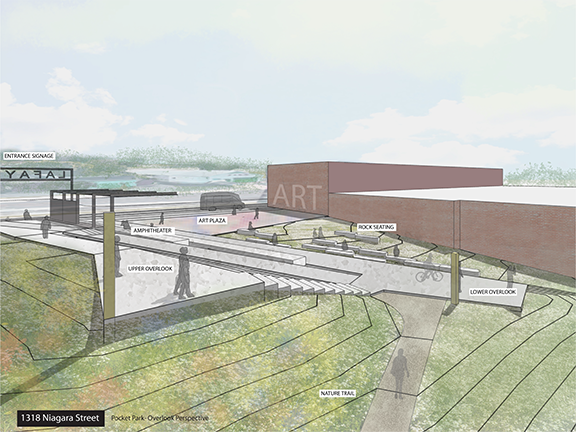
Concept for pocket park looking south and east